
Real estate development: easier than you think
1 June 2026
PORT Blog
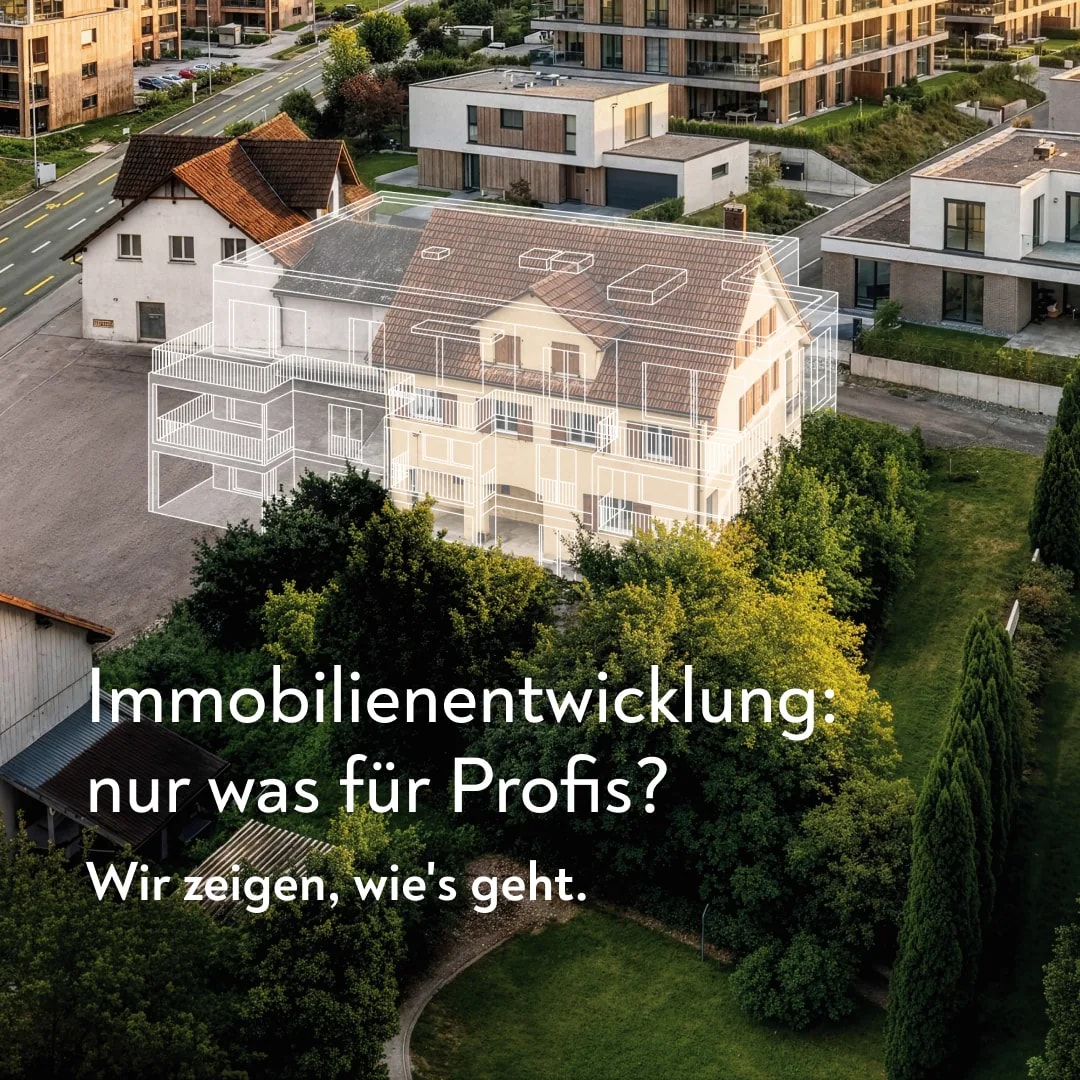
Real estate development? Easier than many think?
Real estate development can be financially attractive, yet for many it sounds «too big», «too complicated» or «only something for professionals». Wouldn't it be easier to simply sell or rent out and benefit straight away, rather than getting into a complicated construction project?
But that impression is misleading. Anyone who asks the right questions early on and prepares the financing properly can manage a development project even as a private individual or «small» investor. In Switzerland, this comes with clear rules but also reliable processes. For non-experts, however, choosing an experienced partner is key.
We outline a simple step-by-step approach.
What does real estate development actually mean?
Let's start with the basics: «to develop» means deliberately increasing the value of a property or building by structurally modifying it. Typical examples include:
- A building is extended upwards or repurposed.
- An older apartment building is replaced with a contemporary new build.
- A property is renovated, energetically optimised or adapted in its layout.
- A plot is used (or built on) more effectively.
- A building is erected on a greenfield site.
Many properties and plots have considerable «hidden» potential. Developing a property is therefore often significantly more attractive than an outright sale or ongoing rental – even if construction still has to take place first.
How does a real estate development project unfold?
Property owners need to ask themselves a few important questions before considering such a project. Before you «fall in love» with ideas or new construction plans, you must examine the hard facts.
- Clarify feasibility and potential precisely: what is realistically permitted on the plot under the zoning and building regulations of a specific location? What total usable floor area is roughly possible? Is there demand for this product (rental flats, ownership, size, standard)? What risks must be clarified (contaminated sites, noise, access infrastructure, heritage protection, neighbourhood, …)?
- This goes hand in hand with a clear idea of the risk you are willing to take: a conservative, «gentle» renovation, or a replacement new build with significant financial leverage? What should happen to the property after the potential development: do you want to keep it or sell it? Are you able to assess the rough costs and returns? Ultimately, this also means clarifying who finances what.
- As a non-expert, whom do you bring in as a partner – or rather, which professional supports you with planning and implementation?
The «preliminary project»
Once you have essentially answered these questions for yourself, the next step is to go deeper. In other words: conceptual work.
- Defining the target group and positioning: whom are we addressing? How much floor area should be created? At what standard? Is a value proposition defined (e.g. «family-friendly», «low-barrier», «urban-compact», «sustainable», …)?
- Observing the surroundings: what does the micro-location look like? Which demand arguments resonate? What competition exists? What are realistic price/rent ranges? Etc.
- Detailing the plans: this involves the schedule, clarifying the authority and permit processes, the project organisation – i.e. involving and collaborating with project partners – and refining cost and risk management.
Financing – knowing how
In contrast to a direct sale, in most cases you need a partner in order to finance the development at all. When selecting that partner, the «best offer» – i.e. the interest rate offered or the equity required – is not the only decisive criterion. Other factors are at least as important:
- Understanding of the project: does the potential partner know different project logics, or only standard mortgages?
- Transparency: how comprehensibly are the terms drafted?
- Flexibility: how does the potential partner handle changes to the plan?
- Experience: which similar projects has the potential partner already realised?
Good financing partners also always check whether you are engaging competent, well-coordinated specialists for the architectural design, permit strategy, cost planning, construction management, sustainability and marketing – and whether responsibilities are clearly defined.
Successfully delivering real estate projects
The typical sequence – from initial review and concept through preliminary project, permit path, financing, realisation and marketing – should be understood as a process, not as one single major hurdle.
When an idea's feasibility is sound from the outset, the permit path is realistically assessed, costs are conservatively and cleanly managed, roles are clear, decisions are made swiftly and financing partners are involved early, the feasibility of a project increases enormously.
In this area, the pitfalls are surprisingly banal – and precisely for that reason easy to avoid:
- Feasibility checked too late (zones, plot ratio, conditions)
- Overly optimistic figures (construction costs, time, marketing)
- Unclear responsibilities (who decides what – and when?)
- Insufficient reserves (financial and time-related)
- Financing considered «only at the end» (instead of as part of the concept)
Real estate development does not have to be a leap into the unknown. With a clear plan, realistic assumptions and experienced partners, projects become well manageable – even for private individuals and smaller investors.